



Instagram’s follower and Following lists are not a reliable timeline of someone’s activity. Open the same list twice, and the order—or the accounts returned—may differ. A follow from two years ago can sit above a follow from yesterday.
That changes how recent follow activity should be tracked and interpreted.
We’ve updated DolphinRadar’s Instagram Recent Follow Tracker to reflect these changes. The updated experience uses a starting list and subsequent observations to identify newly detected accounts, with clearer explanations of what “recent” means and what the displayed timestamps represent.
DolphinRadar’s Recent Follow Tracker saves a public profile’s available Following list as a baseline, then adds newly detected accounts to Following Updates. “Recent” means newly found after that baseline. The displayed time is when DolphinRadar first detected the account, rather than the exact time the follow happened on Instagram.
Why We Updated DolphinRadar’s Recent Follow Tracker
In our observations, Instagram’s follower and Following lists can return different results across visits. Their visible order also does not reliably indicate when a follow occurred.
These are two separate issues:
- List order can change. An account moving toward the top does not establish that it was recently followed.
- Visible results can vary. An account appearing on a later visit does not, by itself, prove that a new follow happened between visits.
For anyone checking follow activity, the distinction matters. A screenshot captures what appeared during one visit. It does not establish the age of each relationship or provide a complete history of changes.
Our product update addresses this uncertainty by making the starting point, subsequent updates, and detection times explicit. DolphinRadar helps users review changes observed over time without treating Instagram’s current list position as evidence of recency.
What Changed in the Updated Experience?
The updated DolphinRadar Recent Follow Tracker makes several rules clearer:
| Area | How the updated experience works |
|---|---|
| First check | DolphinRadar saves the available Following list as a baseline for later comparisons. |
| Meaning of “recent” | Accounts newly detected after the baseline can appear in Following Updates. |
| Accounts in the baseline | Existing baseline accounts are not presented as recent follows simply because of their list position. |
| Following Updates | This view shows accounts newly found after recording began. |
| Displayed timestamps | Times indicate when DolphinRadar first detected an account, rather than its exact Instagram follow time. |
| Historical ordering | The tool does not reconstruct the original follow order of accounts already in the baseline. |
 These rules help answer a practical question: What has DolphinRadar newly observed since recording began?
How the Updated Recent Follow Tracker Works
1. The First Check Establishes a Baseline
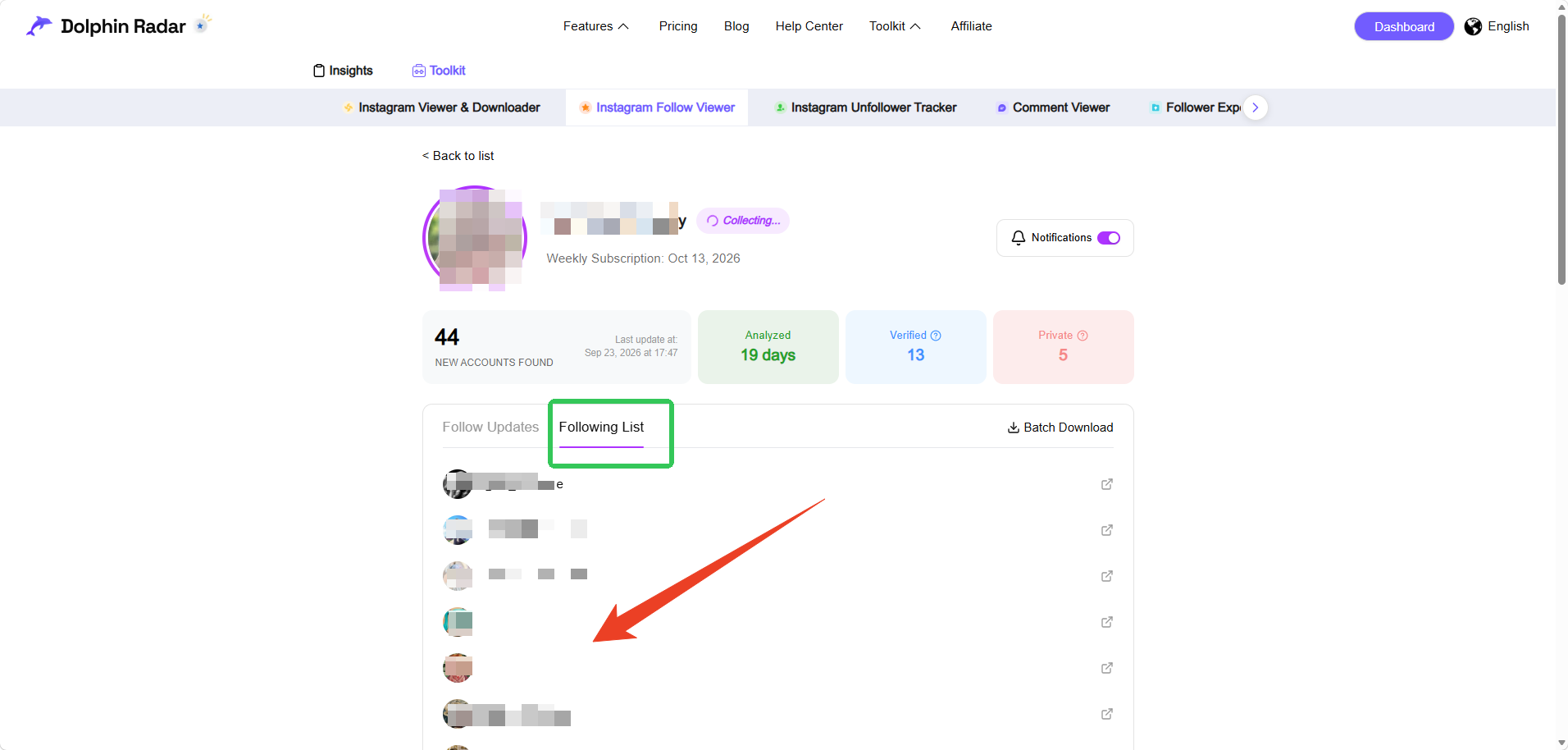
A baseline is the available Following list DolphinRadar saves when recording begins for a profile. It provides a reference for identifying accounts found later.
The first check establishes which accounts are already present in the starting data. It does not establish when each account was followed.
For example, an account in the baseline may have been followed yesterday, last month, or several years ago. Its presence and position cannot reliably distinguish between those possibilities.
To browse the Following information currently available for a public profile, you can also use DolphinRadar’s Instagram Following Viewer.
2. Later Observations Identify Newly Detected Accounts
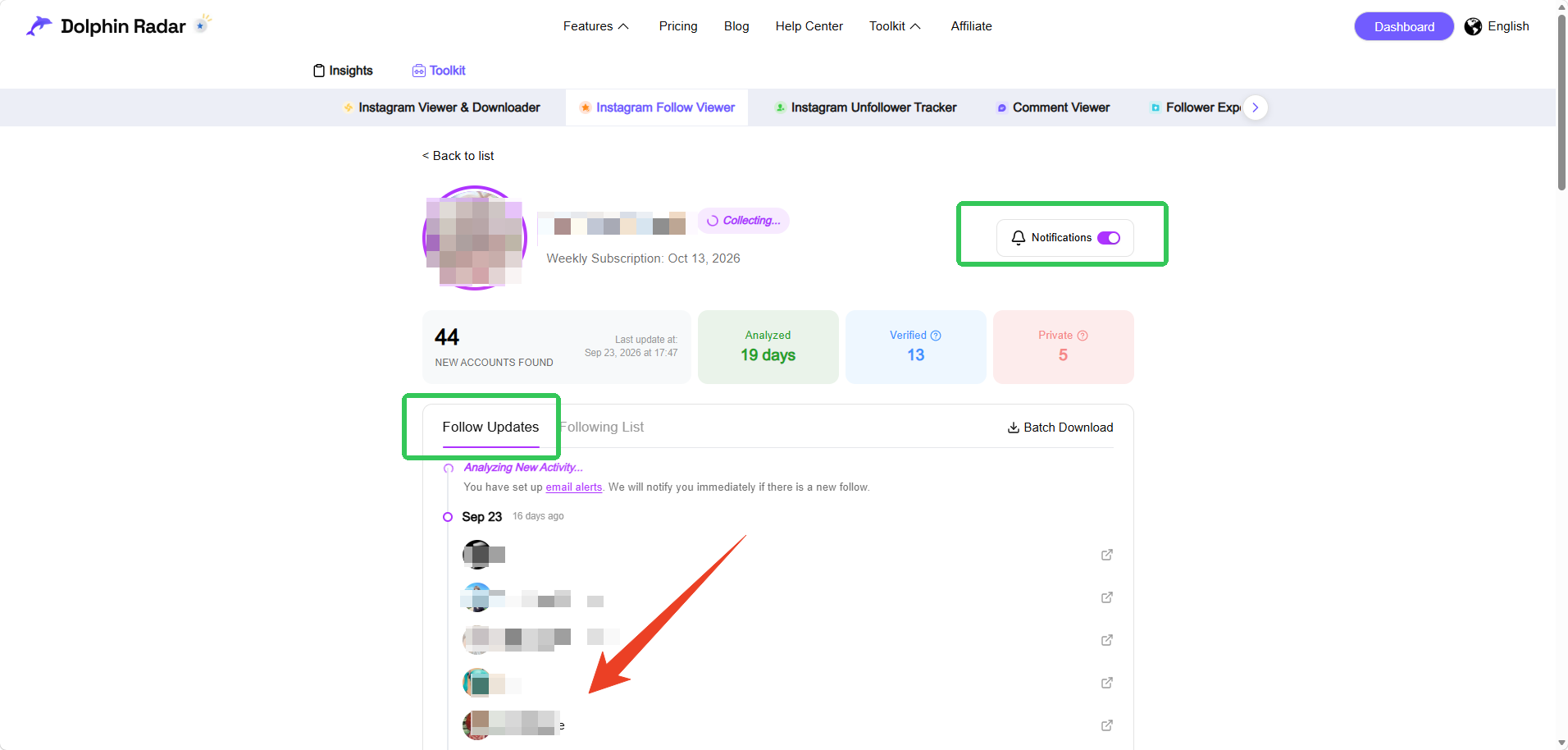
Following Updates is the section where DolphinRadar shows accounts newly detected after the baseline was saved.
DolphinRadar compares subsequent observations with previously recorded information. When an additional account is found, it can appear in Following Updates, allowing you to review the changes DolphinRadar has observed since recording began.
A newly detected account may reflect a new follow. However, “newly detected” describes an observation by DolphinRadar. It does not independently establish the exact moment the relationship began.
This distinction is particularly relevant when available list data is incomplete or changes between checks.
3. Timestamps Show When DolphinRadar Detected an Account
A first-seen time is the time DolphinRadar first detected an account in the tracked profile’s Following information.
Suppose an update displays 3:00 p.m. That timestamp tells you when DolphinRadar found the account. It does not establish that the person tapped “Follow” at exactly 3:00 p.m.
First-seen timestamps provide a timeline of recorded observations. They should be read within that context whenever you review or share a result.
What Will You See on Your First Check—and Later?
The following fictional example illustrates how to interpret the updated tracker.
| Stage | What DolphinRadar records | What the result means |
|---|---|---|
| First check | Accounts A, B, and C appear in the available Following list. | A, B, and C become part of the baseline. Their original follow order is unknown. |
| Later check | DolphinRadar detects Account D for the first time. | D can appear in Following Updates as a newly detected account. |
| Timestamp displayed | D has a first-seen timestamp of Tuesday at 3:00 p.m. | DolphinRadar first detected D at that time. The exact Instagram follow time is not established. |
An account’s position in the initial list does not determine whether it is recent. An account’s first-seen timestamp identifies when DolphinRadar detected it.
This is why the first check and later updates serve different purposes: the first establishes a reference, while subsequent checks build an observation history.
How to Use the Updated DolphinRadar Tracker
To start reviewing Following changes:
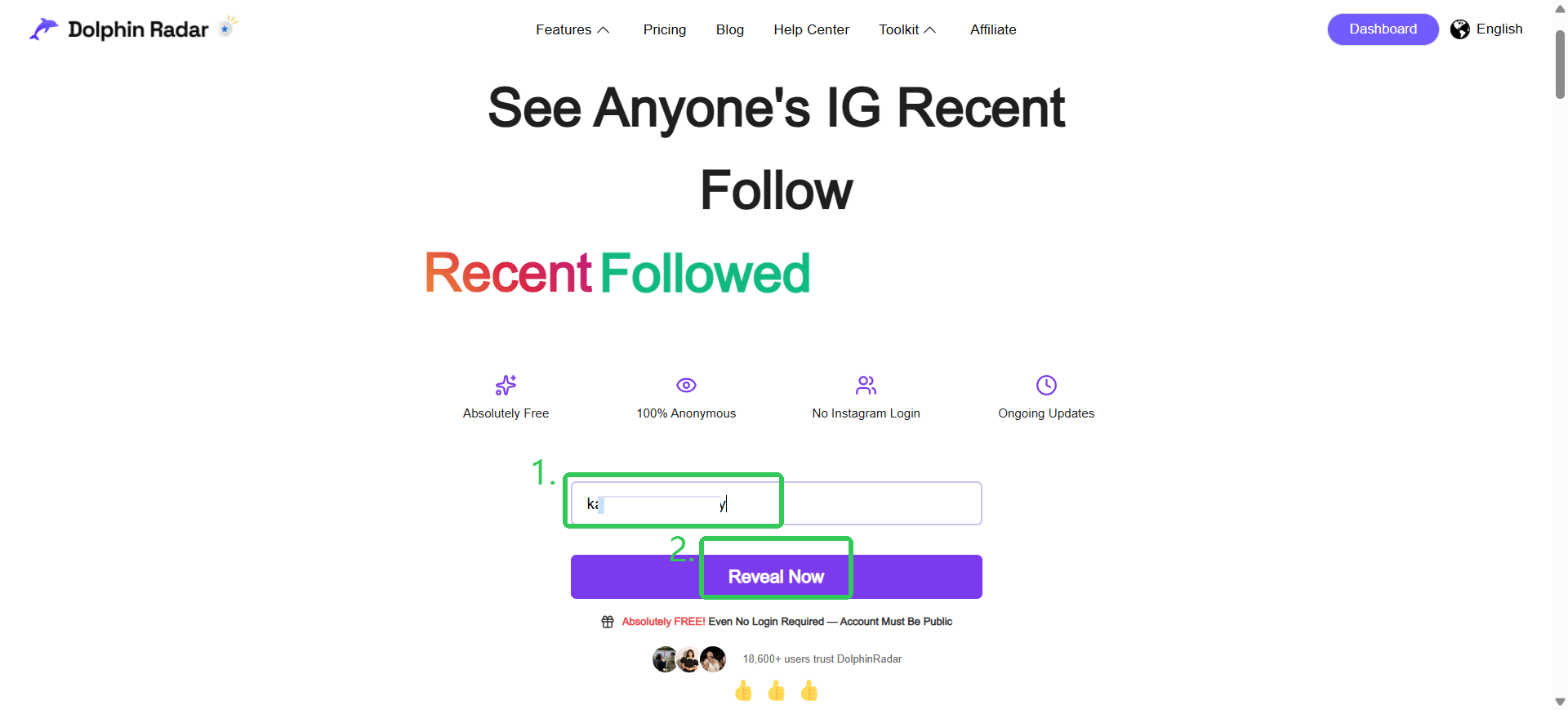
- Open DolphinRadar’s Recent Follow Tracker.
- Enter the username of a supported public Instagram profile.
- Let the first check establish the available Following list as a baseline.
- Return to Following Updates to review accounts newly detected afterward.
- Use the available notification settings if you want email alerts when new accounts appear in Following Updates.
No Instagram login is required to use the public-profile lookup.
Starting earlier gives DolphinRadar an earlier reference point for future observations. The tracker does not reconstruct which baseline accounts were followed most recently before recording began.
Why Following Updates May Be Empty
An empty Following Updates view means there are currently no newly detected accounts to display. It does not conclusively establish that the profile has made no new follows.
The first check may have only just established the baseline. Subsequent observations may not yet have detected an additional account. Data availability can also affect what DolphinRadar can surface.
The Following Viewer explains that large or restricted accounts may return partial or limited results. An empty update view should therefore be interpreted alongside the starting point and available data.
Following, Followers, and Mutuals: What Each Term Means
Instagram relationship terms describe different directions. Keeping them separate makes results easier to interpret.
| Term | Definition |
|---|---|
| Following | Accounts the selected profile follows. |
| Followers | Accounts that follow the selected profile. |
| Mutuals | Accounts with a two-way follow relationship: each follows the other. |
| Baseline | The available starting list saved as a reference for later comparisons. |
| Following Updates | Accounts newly detected in Following information after the baseline. |
| First-seen time | The time DolphinRadar first detected an account in the relevant Following information. |
This article explains the updated Following Updates workflow. Followers and mutual connections describe different relationships and should be interpreted according to the explanations provided in their respective views.
What the Updated Results Can Tell You
DolphinRadar’s Recent Follow Tracker helps you identify accounts newly observed after recording begins, review their first-seen times, and follow those observations over time.
That can support research into public creators, brands, competitors, and communities. A newly detected connection may provide a useful lead for further investigation.
The results have clear limits:
- They do not establish the exact Instagram follow time.
- They do not reconstruct the original order of existing baseline relationships.
- They do not guarantee a complete list for every public profile.
- They do not provide access to private profiles.
- They do not prove a friendship, partnership, or personal intention.
For example, a creator following a brand may be relevant to partnership research. The follow alone does not confirm that a commercial agreement exists.
FAQ
1. Why did DolphinRadar update its Recent Follow Tracker?
DolphinRadar updated its Recent Follow Tracker because Instagram’s list presentation does not reliably reveal follow chronology. The updated experience uses a baseline and subsequent observations, with clearer definitions of recent updates and detection timestamps.
2. What does “recent” mean in DolphinRadar?
In DolphinRadar’s Recent Follow Tracker, “recent” means newly detected after the profile’s starting Following list was saved. Accounts already in that baseline are not classified as recent solely because they appear near the top of a list.
3. Will my first check show who someone followed yesterday?
The first check establishes the available Following list as a baseline. It does not reliably identify which existing account was followed yesterday or reconstruct the follow order before recording began.
4. Is the displayed time the exact Instagram follow time?
No. The displayed time indicates when DolphinRadar first detected the account. It should not be interpreted as the exact moment the follow happened on Instagram.
5. Does a newly detected account always mean a new follow just happened?
No. A newly detected account is an account DolphinRadar found after the baseline. It may reflect a new follow, but variations in available list data mean detection alone does not establish exactly when the relationship began.
6. How often are Following Updates added?
Following Updates are added as new accounts are found. Detection timing can vary, so the tracker’s timestamps and update timing should not be treated as an instant record of every Instagram follow action.
7. Can DolphinRadar track private Instagram accounts?
No. DolphinRadar’s Recent Follow Tracker works with supported public Instagram profiles. It does not bypass private-account visibility settings.
Start Recording Future Following Changes
The updated tracker gives you a defined starting point and a clearer way to interpret what DolphinRadar finds afterward.
Enter a public Instagram username in DolphinRadar’s Recent Follow Tracker to establish a baseline and begin reviewing newly detected Following accounts over time.
Updated on October 10.